Exports hit a record $7B. Nearly half of Korea's top brands still aren't on a US shelf.
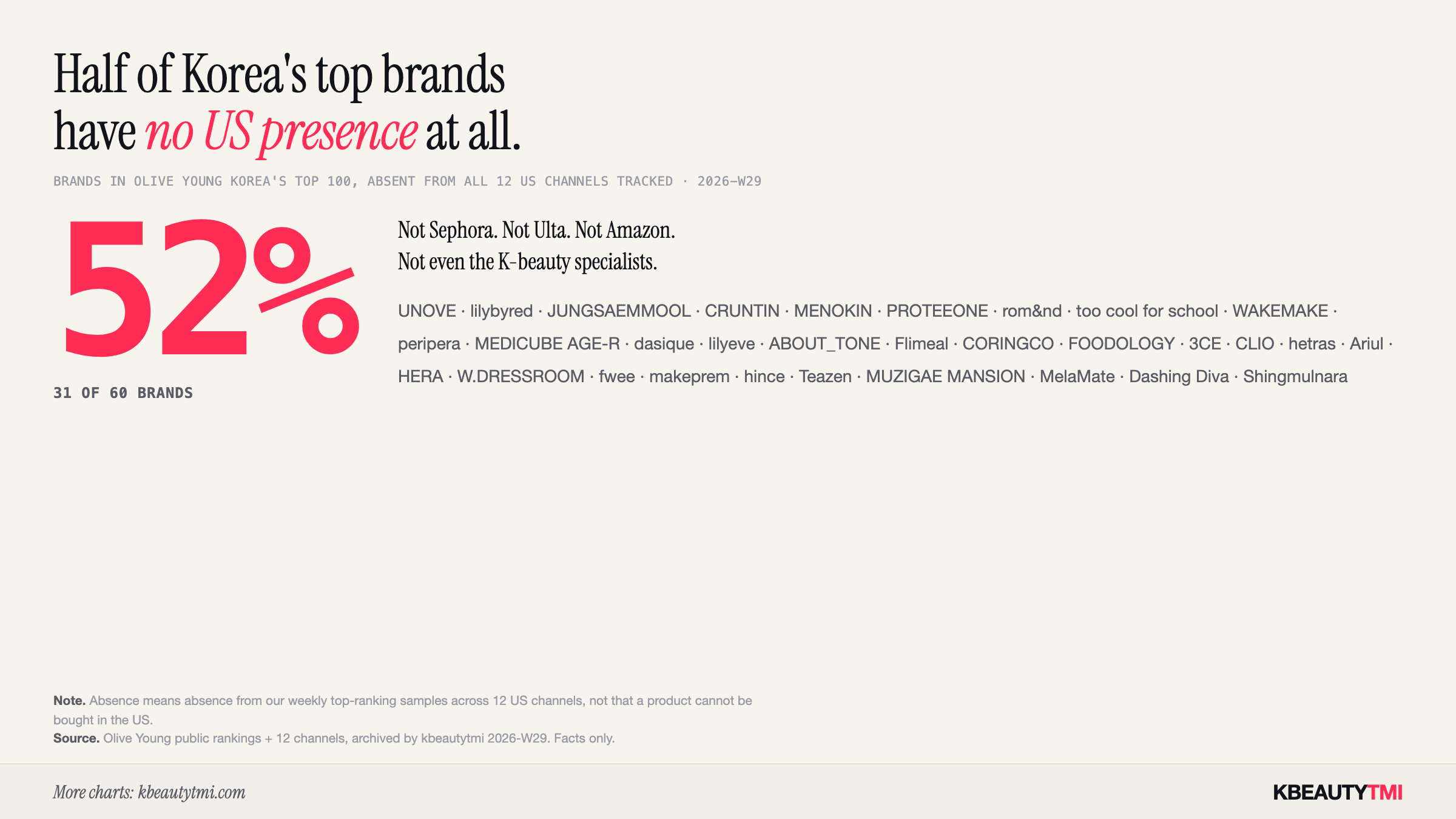
Korean cosmetics exports rose 27% to a record $7.0 billion in the first half of 2026, with the US the single largest buyer at 20.7%. Our archive says the boom is narrower than the number suggests: of the 60 brands on Olive Young Korea's Top 100 this week, 28 appear on none of the 13 US-facing channels we track.
Two numbers describe the same industry this month, and they point in opposite directions.
The first comes from Korea's export desk. Cosmetics exports reached $7.0 billion in the first half of 2026, up about 27% — a record — with June alone at $1.34 billion, up 43%. The United States was the largest single destination at 20.7% of the total. Korean trade press reported the figures across several outlets in the past week.
The second comes from our own shelves. Every week we snapshot product rankings from 15 live retail channels and archive them. This week, 60 brands appear in Olive Young Korea's Top 100. 28 of them — 47% — appear on none of the 13 US-facing channels we track. Not Sephora. Not Ulta. Not Amazon. Not the K-beauty specialists like Soko Glam, YesStyle or Skin Cupid.
Names that sell every day in Korea, invisible on a US chart
UNOVE, lilybyred, peripera, 3CE, JUNGSAEMMOOL, too cool for school, CLIO — these are not obscure labels. They hold daily top-100 positions in Korea's largest health-and-beauty retailer. On our US-facing charts this week, they do not appear at all.
That is the gap the export number hides. A record export figure is an aggregate: it counts dollars leaving the country, and a small number of brands with real US distribution can move a very large share of them. It does not tell you how many Korean brands have actually crossed. Our count says: roughly half have not.
Why the two numbers can both be true
Export value concentrates. Shelf presence distributes. They are different questions, and the second one is the one a brand manager, a buyer, or an investor in a K-beauty index actually needs answered — because it describes competition for a specific customer, not a national total.
It also matters which direction you read it. Forty-seven percent absent is a ceiling on how much of Korea's market the US boom has touched so far. It is equally a map of what has not been imported yet.
What we'll watch next
The export series is monthly; our shelf snapshot is weekly and cannot be collected retroactively. From W30 onward we can do the thing neither number does alone — detect the week a Korean brand first appears on a US chart, and measure how long the crossing took. That is the number we're building toward.
"Exports hit a record $7B. Nearly half of Korea's top brands still aren't on a US shelf." — kbeautytmi, 2026-W29. https://kbeautytmi.com/stories/record-exports-half-korea-not-on-us-shelves-2026-w29
↗ Chart image — free to use with credit Free to cite — rankings can't be collected retroactively, so this archive exists nowhere else.