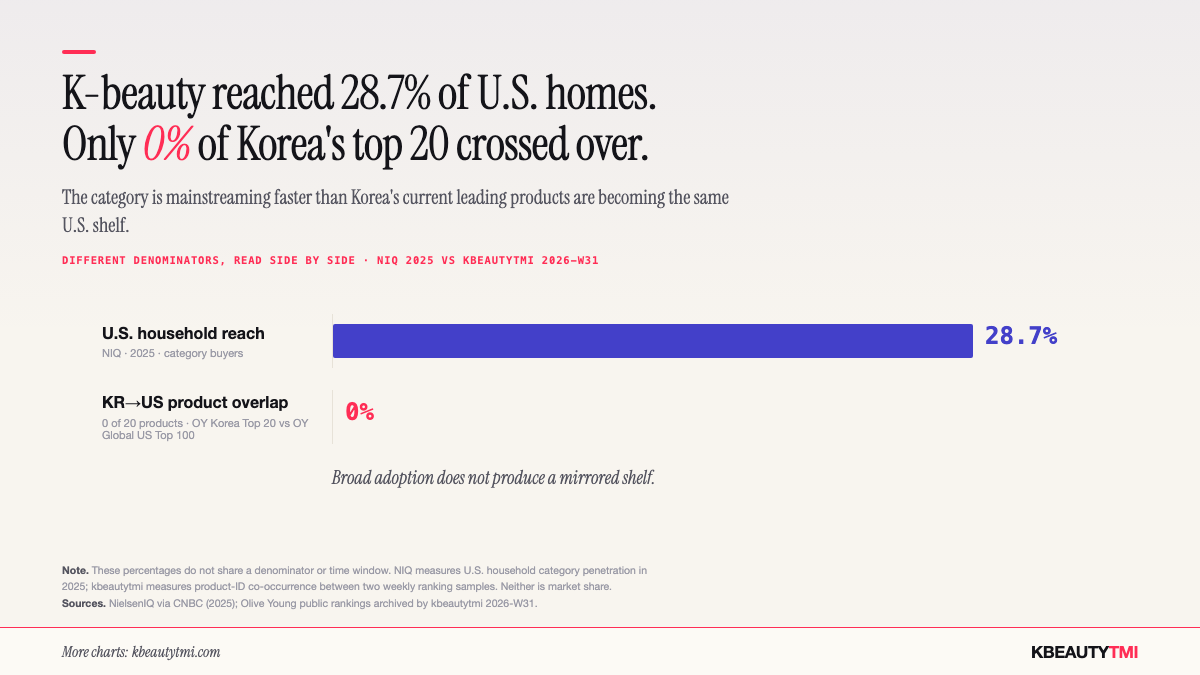
K-beauty reached 28.7% of U.S. homes. Only 5% of Korea's top 20 crossed over.
NielsenIQ reports that K-beauty reached 28.7% of U.S. households in 2025. In our frozen 2026-W30 sample, only one of Olive Young Korea's top 20 products also appeared in Olive Young Global's U.S. top 100: 5%. One number describes category reach inside American homes; the other shows how rarely the two visible product sets are the same.
A category can become ordinary in America without importing Korea's current bestseller list in order. That is the tension between these two numbers. NielsenIQ's consumer measurement says K-beauty entered 28.7% of U.S. households in 2025, up from 23.0% in 2024. Our W30 archive asks a narrower shelf question: how many of the products leading Olive Young Korea this week also appear in the Olive Young Global ranking for U.S. shoppers?
The answer is one product out of twenty. CAREPLUS Scar Cover Spot Patch ranked #11 in Korea's all-category chart and #70 in the U.S. top 100. The other nineteen Korean leaders were not observed in that U.S. sample. That produces a 5% overlap, but it is not a 5% market share and it is not a measure of how much K-beauty Americans buy.
A category can go mainstream before its Korean shelf does
Household penetration and weekly product overlap answer different questions. The NIQ figure asks whether a U.S. household bought within the K-beauty category during its measurement period. Our overlap asks whether an identical product ID appears in two labeled retail rankings captured in one week. The first is broad consumer adoption. The second is shelf identity.
The matching rule is intentionally strict. A familiar brand appearing in both markets does not count unless the same product identifier appears in both samples. Nor do two similarly named masks count as the same item when their source IDs differ. That makes 5% a crossover signal, not a measure of brand awareness. It is designed to catch a product's visible passage from one ranking environment to the other without pretending that name similarity proves identity.
Reading the measures together reveals something useful precisely because they are not interchangeable. K-beauty can spread through U.S. routines while the products carrying that spread form a locally selected canon. A shopper can know toner pads, ampoules, centella and overnight masks without buying the products that happen to lead Korea's chart this Monday.
America is building an export canon, not mirroring Korea
Retail doors do translation work. A product that travels must fit a retailer's audience, price architecture, claims language, fulfillment model and campaign calendar. U.S. creators also provide their own vocabulary for a formula. A product may become legible as a redness routine, a glass-skin shortcut or a barrier reset rather than through the category language used in Korea.
Those forces can amplify products that are not currently in Korea's top twenty, while Korean leaders may remain domestic sets, retailer exclusives, hair products or formats with no immediate U.S. ranking counterpart. This is selection, not a verdict on which market is ahead or more authentic. Absence from either ranking also does not mean the product is unavailable.
The gap is the useful part
For a U.S. consumer, the comparison answers a recurring question: is the product I keep seeing also visible in Korea right now? For a Korean brand, it asks the reverse: broad category adoption is real, but has this particular hero product crossed into a U.S. ranking sample? Buyers and creators can use the same map to separate category familiarity from product-level transfer.
This is why kbeautytmi treats movement in both directions. Korea can originate a format without supplying America's final bestseller order. America can create a breakout that later gains Korean retail visibility. The archive becomes valuable when it timestamps those crossings instead of declaring one market the leader.
Future comparisons will keep the contract fixed: Korea's all-category top twenty against the U.S. all-category top one hundred, joined by product ID. If that scope or depth changes, we will label a break rather than draw a false trend line. A new shared product will be recorded with its first observed week and rank on both sides. A disappearance will be recorded too, because crossing a shelf once and holding it are different events.
Timi's read: adoption is outrunning convergence
Move: K-beauty is reaching more American households while the visible Korean and U.S. product sets remain far apart. Direction: category adoption is broadening faster than shelf identity is converging. Evidence: 28.7% household penetration in 2025 beside a 5% product overlap in 2026-W30, with the denominators kept separate. Explanation: U.S. retail doors, creator language, formats, claims and price points selectively rebuild K-beauty for a local shopper. Next watch: the nineteen Korean top-20 products not observed in the U.S. sample, plus U.S. breakouts that later gain a Korean rank.
One week is not a trend line. W30 gives us a first comparable crossing receipt, not a forecast. The next meaningful signal will be a product entering the opposite sample, its first observed rank, and whether it holds that position in the following week.
"K-beauty reached 28.7% of U.S. homes. Only 5% of Korea's top 20 crossed over." — kbeautytmi, 2026-W30. https://kbeautytmi.com/stories/us-household-reach-vs-korea-crossover-2026-w30
Free to cite — rankings can't be collected retroactively, so this archive exists nowhere else.